
Conferencia invitada de Samir Gandesha (Simon Fraser University), «Transgressive Populism or Technofascism«. La conferencia, organizada en colaboración entre la SETC, el Máster en Estudios Avanzados en Filosofía de la UCM y el proyecto «Estética y transformación digital de la sociedad» (PID2023-149638OB-I00), se celebrará el miércoles 29 de abril a las 18:30 en el Seminario 217 de la Facultad de Filosofía de la Universidad Complutense de Madrid (Edificio A).
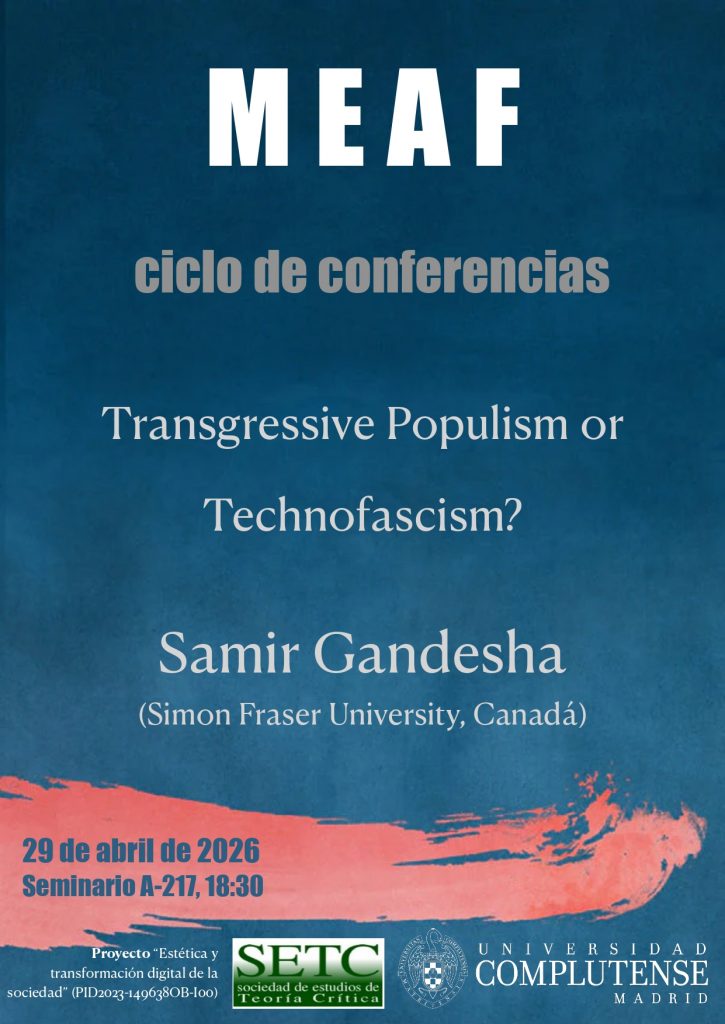
Transgressive Populism or Technofascism? Samir Gandesha, Global Humanities, Simon Fraser University
Over the past decade, the concept of fascism has returned with a vengeance in attempts to understand the planetary shift to the far-right. As several commentators have rightly indicated, the fascism of the 1920s and 1930s is considerably different from the fascism that appears to be shaping the politics of the contemporary global order. The latter has been understood along two distinct explanatory axes. The first holds that it is a species of authoritarian populism in which movements purporting to embody or personify the will of the “people” are driven to transgress every moral, epistemic and aesthetic limit in manifesting sovereign power. The second explanatory axis is that contemporary fascism is a form of what has been referred to as “technofascism,” which has been given politico-philosophical shape by “Dark Enlightenment” thinkers such as Nick Land and Curtis Yarvin who articulate starkly anti-democratic positions. While the first form could be said to undermine liberal democracy from within by pushing it in an increasingly “illiberal” direction, the second form brazenly attacks the very idea of democracy from without, by explicitly stating its incompatibility with capitalist social relations. In this lecture, I will pose the question as to which explanation best grasps the contemporary authoritarian turn and how can it be opposed.
***
El jueves 30 de abril a las 11:00 se celebrará un seminario interno de debate con Samir Gandesha a partir de lectura de textos bajo el título «(Non-)Identity Politics and Mimesis«. Las personas interesadas en participar en el seminario y recibir los textos han de escribir un correo electrónico a la setc@setcrit.net